What are STEM MBA Programs in the US (2026): Compare Schools, Costs & Career Outcomes
Artificial intelligence is no longer a buzzword confined to Silicon Valley. It’s reshaping industries, redefining job roles, and raising the bar for what it means to be an effective business leader. In this new era, the ability to understand and leverage technology isn’t just a competitive advantage; it’s a baseline requirement.
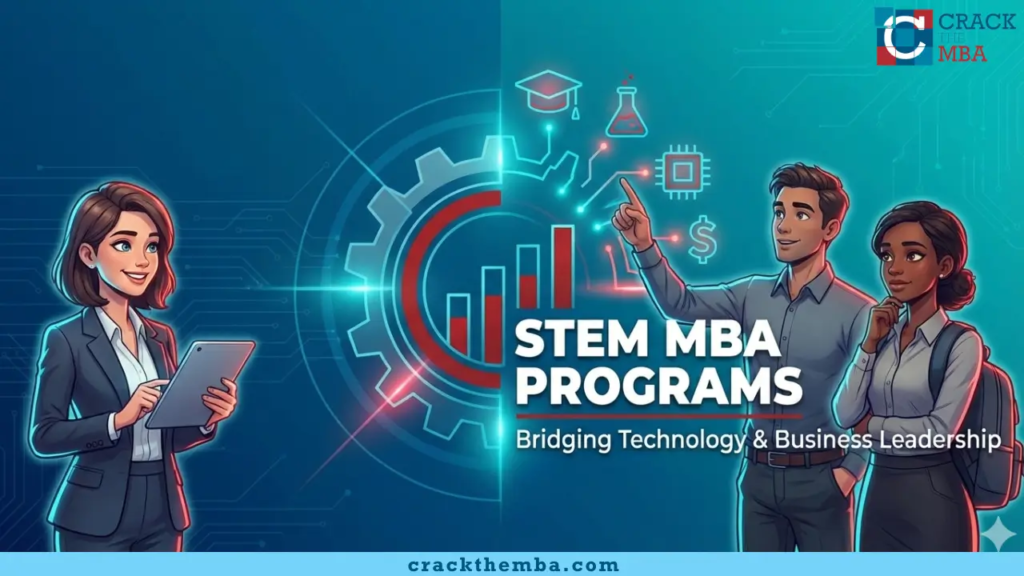
Traditional MBA programs have long been the gold standard for business education, but a newer designation is quietly reshaping the landscape: the STEM MBA. A STEM MBA is a Master of Business Administration program officially designated as a Science, Technology, Engineering, and Mathematics curriculum — one that goes beyond conventional business training to build the quantitative rigor and technical fluency today’s economy demands.
As AI continues to automate routine decision-making and generate unprecedented volumes of data, businesses are hungry for leaders who can sit at the intersection of strategy and technology. STEM MBAs are increasingly being designed with exactly that in mind equipping graduates to not just manage AI-driven change, but to drive it.
Whether you’re an international student looking to maximize your time in the U.S. job market or a professional aiming to future-proof your career, a STEM MBA offers a compelling path forward. In this post, we’ll walk through everything you need to know — from what the designation actually means, to top programs, career outcomes, and how to decide if it’s the right fit for you.

The STEM MBA Guide
Everything you need to know, summarized at a glance.
The 3 Big Advantages
3 Years of OPT
A massive 24-month extension allows international students 3 full years of US work authorization to secure H-1B sponsorship.
Higher ROI
Graduates enjoy avg. starting salaries of $125k+ and a clear runway into high-paying Tech, FinTech, and Data roles.
AI & Tech Readiness
The core curriculum forces a blend of leadership, management science, and technical fluency that tomorrow’s employers demand.
The Showdown
Traditional MBA
- Core Focus Leadership & Strategy
- International OPT 12 Months
- H-1B Prospects Moderate (1 cycle)
- Top Hiring Industries Consulting, Banking, FMCG
STEM MBA
- Core Focus Analytics, AI + Strategy
- International OPT 36 Months (3 Years)
- H-1B Prospects High (3 cycles)
- Top Hiring Industries Tech, FinTech, Healthcare, AI
Who is this best for?
The International Student
If building a long-term career in the United States is the primary goal, the 3-year OPT runway makes a STEM MBA the safest, most strategic investment.
The Tech Professional Stepping Up
Engineers, developers, and data scientists looking to break the “technical ceiling” and move into product management, entrepreneurship, or executive leadership.
The Future-Proofer
Consultants and finance professionals who recognize that AI and data literacy are rapidly becoming the baseline requirement for modern business leadership.
STEM MBA: The Ultimate Summary
The 3 Big Advantages
1. 3 Years of OPT: A massive 24-month extension allows international students 3 full years of US work authorization to secure H-1B sponsorship.
2. Higher ROI: Graduates enjoy avg. starting salaries of $125k+ and a clear runway into high-paying Tech, FinTech, and Data roles.
3. AI & Tech Readiness: The core curriculum forces a blend of leadership, management science, and technical fluency that tomorrow’s employers demand.
Traditional MBA vs. STEM MBA
Traditional MBAs focus on Leadership & Strategy, offer 12 months of OPT, have moderate H-1B prospects, and hire heavily into Consulting, Banking, and FMCG.
STEM MBAs focus on Analytics, AI, and Strategy, offer 36 months of OPT, have high H-1B prospects, and hire heavily into Tech, FinTech, Healthcare, and AI.
Who is this best for?
The International Student looking for long-term US career options. The Tech Professional (engineers, developers) stepping up into executive leadership. The Future-Proofer (consultants, finance) recognizing data literacy as a baseline requirement.
What Makes an MBA “STEM-Designated”?
Not every MBA that touches on technology or data qualifies as a STEM program. The designation is an official classification rooted in the U.S. Department of Homeland Security’s Classification of Instructional Programs (CIP) code system. Schools must apply for and receive this designation by demonstrating that their curriculum meets specific quantitative and analytical thresholds.
At its core, a STEM-designated MBA emphasizes subjects like data analytics, operations research, quantitative methods, financial engineering, and technology management. Rather than treating these as electives, STEM MBAs integrate them into the foundational coursework, ensuring that every graduate leaves with a working command of analytical tools and frameworks.
The process of earning the designation isn’t automatic. Business schools must align their curriculum with the appropriate CIP code, typically falling under categories like “Management Science” or “Business Analytics,” and submit documentation to the relevant authorities. As a result, the designation carries real weight and signals a meaningful commitment to technical rigor.
It is also worth noting that not all STEM MBAs are built the same. Some programs earn the designation for their full-time MBA curriculum, while others apply it only to specific concentrations or tracks. When evaluating programs, it is important to confirm exactly what is covered under the STEM umbrella and how deeply the technical components are woven into the overall degree.
And yes, the good news is, many top business schools in the US now offer STEM MBA options, either for the full program or specific tracks within it.
The Key Benefits of a STEM MBA
A STEM MBA isn’t just a credential upgrade. For many graduates, it’s a career-defining decision backed by real, measurable advantages.
3 Years to Build Your Career in the U.S. (Not 1)
For international students, this is often the single biggest motivator. Standard MBA graduates receive 12 months of Optional Practical Training (OPT). STEM MBA graduates receive a 24-month extension on top of that, bringing the total to 3 full years of work authorization. That’s three years to gain experience, impress employers, and improve H-1B sponsorship odds without racing against the clock right after graduation.
A Job Market That’s Actively Looking for You
The demand for STEM-literate business professionals isn’t a trend. It’s a structural shift. By 2024, the U.S. was projected to face a deficit of 1.1 million STEM workers, creating a wide-open runway for graduates who combine technical skills with business strategy. Top tech firms like Amazon and Google are now among the biggest employers of MBA graduates, and they increasingly prefer candidates who can bridge data fluency and executive decision-making.
AI Is Raising the Bar. STEM MBAs Clear It.
As AI takes over routine analysis and reporting, the roles that remain and grow are those requiring human judgment applied to complex, data-rich environments. STEM MBAs are built for exactly this. Programs at schools like MIT Sloan and Chicago Booth are already incorporating AI-driven analytics, machine learning applications, and predictive modeling into core coursework. In 2024, Harvard’s MBA program became fully STEM-certified following the addition of data science and AI to its core curriculum — a signal of where business education is heading across the board.
At a Glance: STEM MBA vs. Traditional MBA
| Factor | Traditional MBA | STEM MBA |
|---|---|---|
| OPT Duration | 1 year | 3 years |
| H-1B Competitiveness | Moderate | High |
| Core Curriculum Focus | Strategy, Leadership, Finance | Analytics, Technology, AI + Business |
| Top Hiring Industries | Consulting, Banking, FMCG | Tech, Fintech, Healthcare, Consulting |
| Avg. Early Career Salary | $115,000 | $125,000+ |
| Best Suited For | Generalist business leaders | Tech-savvy, data-driven professionals |
A Strong Return on Investment
The financial case holds up, too. Graduates with a combined STEM and MBA education earn, on average, some of the highest early-career salaries across all graduate degree combinations, with earnings continuing to grow with experience. When you factor in the extended OPT window, access to higher-growth industries, and the ability to compete for roles that non-STEM MBAs often cannot, the degree pays for itself in ways that go well beyond the starting salary.
Top STEM MBA Programs in the US (2026)
From coast to coast, many of the top business schools in the US have introduced full or partial STEM-designated MBA options. Here’s a curated list of the best ones to consider in 2025 — especially if you’re looking to combine business leadership with long-term work potential in the US.
Top STEM-Designated MBA Programs
2026 Eligibility Guide for International Students
| Business School | Notable STEM Focus Areas |
|---|---|
| Harvard Business School Added 2024 | Data Science, Artificial Intelligence |
| Stanford GSB | Data-Driven Decision Making, Tech Strategy |
| MIT Sloan | AI, Data Science, Business Analytics |
| Chicago Booth Added 2020 | Analytics, Finance, Statistics |
| Northwestern Kellogg | AI Strategy, Technology Management |
| Columbia Business School | FinTech, Business Analytics, Digital Strategy |
| Yale SOM Added Late 2024 | Quantitative Methods, Management Science |
| Duke Fuqua Upgraded 2022 | Management Science, Technology |
| NYU Stern | Quantitative Finance, FinTech |
| UC Berkeley Haas | Data Analytics, Operations, Technology |
| UCLA Anderson | Technology Management, Data Analytics |
| UNC Kenan-Flagler | Business Analytics, Innovation |
| Vanderbilt Owen Added 2025 | Analytics, General Management |
| Cornell Johnson | Business Analytics, Technology Management |
| Carnegie Mellon Tepper | Management Science, Data Analytics |
| Rochester Simon First U.S. STEM MBA | Finance, Pricing Strategy |
| ASU W.P. Carey | AI, Business Analytics, Supply Chain |
| Business School | Required STEM Pathways |
|---|---|
| The Wharton School 9 Majors Only | Business Analytics, Quantitative Finance, AI for Business, Operations, Economics |
| Michigan Ross 7 Tracks Only | AI in Business, Marketing Analytics, Supply Chain Management |
| UT Austin McCombs 14 Concentrations | Must select from Management Science or Financial Mathematics degree codes |
| USC Marshall Specialization | Management Science Specialization |
| Dartmouth Tuck Specialization | Management Science and Quantitative Methods Portfolio |
| Washington Univ. Olin Opt-In Pathway | Requires completing 15 additional STEM credit hours |
| UVA Darden 12-Credit Option | Management Science Degree Pathway |
| Georgetown McDonough Major | Management Science Major |
| Indiana Kelley 5 Majors Only | Business Analytics, Finance, Supply Chain, Accounting, or Marketing |
Top STEM-Designated MBA Programs
Full Program STEM MBAs include: Harvard Business School (since 2024), Stanford GSB, MIT Sloan, Chicago Booth, Northwestern Kellogg, Columbia Business School, Yale SOM (since 2024), Duke Fuqua (since 2022), NYU Stern, UC Berkeley Haas, UCLA Anderson, UNC Kenan-Flagler, Vanderbilt Owen (since 2025), Cornell Johnson, Carnegie Mellon Tepper, Rochester Simon, and ASU W.P. Carey.
Schools requiring specific STEM tracks or majors include: Wharton (9 STEM majors like Business Analytics), Michigan Ross (7 tracks), UT Austin McCombs (14 concentrations), USC Marshall (Management Science Specialization), Dartmouth Tuck (Management Science specialization), Washington University Olin (requires 15 additional STEM credit hours), UVA Darden (12-credit Management Science pathway), Georgetown McDonough (Management Science major), and Indiana Kelley (5 majors).
As of 2026, nearly every top-30 full-time MBA program in the U.S. offers at least one pathway to a STEM designation. The critical distinction remains the same: is the entire program STEM-designated, or only specific tracks and majors within it? This matters enormously for international students who need to plan their course selection carefully to secure their 24-month OPT extension.
Here is where the leading programs stand today:
| School | Designation Type | Notable STEM Focus Areas |
|---|---|---|
| MIT Sloan | Full Program | AI, Data Science, Business Analytics, Technology Management |
| Harvard Business School | Full Program (since 2024) | Data Science, Artificial Intelligence |
| Stanford GSB | Full Program | Data-Driven Decision Making, Innovation, Technology Strategy |
| Columbia Business School | Full Program | FinTech, Business Analytics, Digital Strategy |
| Chicago Booth | Full Program (since 2020) | Analytics, Finance, Statistics, Management Science |
| Northwestern Kellogg | Full Program (1Y and 2Y) | AI Strategy, Analytics, Technology Management |
| Yale SOM | Full Program (since Oct 2024) | Quantitative Methods, Management Science |
| Duke Fuqua | Full Program (since 2022) | Management Science, Technology |
| NYU Stern | Full Program | Quantitative Finance, Business Analytics, FinTech |
| UC Berkeley Haas | Full Program | Data Analytics, Operations, Technology, Finance |
| UCLA Anderson | Full Program | Technology Management, Data Analytics, Finance |
| UNC Kenan-Flagler | Full Program | Business Analytics, Management Science, Innovation |
| Vanderbilt Owen | Full Program (since 2025) | Analytics, General Management |
| Cornell Johnson | Full Program | Business Analytics, Technology Management |
| Carnegie Mellon Tepper | Full Program | Management Science, Data Analytics, AI |
| Rochester Simon | Full Program | First U.S. STEM MBA; Finance, Pricing Strategy |
| ASU W.P. Carey | Full Program | AI, Business Analytics, Supply Chain, Consulting |
| Wharton | Select Majors Only | Finance, Business Analytics, AI for Business, Quantitative Finance |
| Michigan Ross | Select Tracks Only | AI in Business, Marketing Analytics (7 STEM tracks) |
| UT Austin McCombs | Select Tracks Only | 14 STEM concentrations under Management Science |
| USC Marshall | Select Track Only | Management Science Specialization |
| Dartmouth Tuck | Select Majors Only | Management Science Specialization |
| Washington Univ. Olin | Select Track Only | Requires opt-in to 15 additional STEM credit hours |
| UVA Darden | Select Track Only | Management Science Degree Option (12-credit pathway) |
| Georgetown McDonough | Select Track Only | Management Science Major |
| Indiana Kelley | Select Majors Only | 5 STEM majors: Analytics, Finance, Supply Chain, Accounting, Marketing |
What This Means for You
If you are an international student, where you land in this table matters a lot. At schools with a full-program designation like MIT Sloan, Columbia, Yale SOM, or Duke Fuqua, every student graduates with STEM status automatically, regardless of their electives.
Conversely, at schools like Wharton, Michigan Ross, or UT Austin McCombs, your eligibility for the 24-month OPT extension depends entirely on which major or concentration you choose to pursue. You must declare and complete a specific STEM track to qualify for the visa extension.
It is also worth noting a significant milestone: Harvard’s full STEM certification in 2024 fundamentally shifted the landscape of the elite M7 group. Today, six of the seven most prestigious U.S. business schools offer fully STEM-designated MBAs. Wharton remains the sole exception in the M7, still requiring students to explicitly declare one of nine approved STEM majors to qualify.
That massive shift across the top tier signals that STEM is no longer a niche or purely highly-technical consideration in business education. Today, data-driven management is the new baseline.
Do you want to pursue a STEM MBA?
At Crack The MBA, we have helped hundreds of students get into top MBA programs around the world. We would be happy to help you, too. Get in touch with us to learn more about our MBA application services.
Next, let’s compare how a STEM MBA stacks up against a traditional MBA — and why that distinction really matters for your future.
STEM MBA vs. Traditional MBA: Which Is Right for You?
Choosing between a STEM MBA and a traditional MBA is less about which is better and more about which is better for you. Both degrees open significant doors, but they attract different profiles, build different skill sets, and lead to different career outcomes. Here is a clear breakdown to help you think it through.
The Core Difference
A traditional MBA is built around leadership, strategy, organizational behavior, and general management. It produces well-rounded business generalists who can step into a wide range of industries and functions. A STEM MBA does all of that and layers in quantitative rigor, data fluency, and technical literacy. The result is a graduate who is equally comfortable in a boardroom and a data strategy meeting.
Side-by-Side Comparison
| Factor | Traditional MBA | STEM MBA |
|---|---|---|
| Core Curriculum | Strategy, Leadership, Finance, Marketing | Analytics, AI, Technology Management + Business Core |
| Quantitative Depth | Moderate | High |
| OPT Duration (International Students) | 1 year | 3 years |
| H-1B Competitiveness | Moderate | High |
| Top Hiring Industries | Consulting, Banking, FMCG, Retail | Tech, FinTech, Healthcare, Consulting, AI |
| Common Job Titles | General Manager, Strategy Consultant, Marketing Director | Product Manager, Data Strategist, Tech Consultant, AI Business Lead |
| Avg. Starting Salary | ~$115,000 | ~$125,000+ |
| Best Suited For | Generalist leaders, career switchers into business | Tech-savvy professionals, international students, data-driven thinkers |
| AI Readiness | Developing | Built-in |
| Program Availability | Widespread globally | Primarily U.S.-based |
Who Should Choose a Traditional MBA?
A traditional MBA still makes tremendous sense if you are targeting general management, entrepreneurship, or industries where relationship-building and leadership are the primary currency. If you are career switching into business from a non-technical background, a traditional MBA may also feel like a more natural on-ramp, offering a broader foundation without demanding prior quantitative experience.
Who Should Choose a STEM MBA?
A STEM MBA is the stronger choice if you are an international student who wants to maximize your time in the U.S. workforce, a professional in a data-heavy field looking to move into leadership, or anyone whose target industry sits at the intersection of technology and business. In a world where AI is reshaping entire sectors, having technical fluency baked into your MBA is an increasingly valuable differentiator.
The gap between the two is narrowing as more traditional programs incorporate analytics and AI into their curricula. But for now, if you know that data, technology, and innovation will define your career path, the STEM MBA offers a more purposefully built foundation for that future.
Who Should Go for a STEM MBA?
A STEM MBA is a powerful degree, but it is not a one-size-fits-all solution. The candidates who get the most out of it tend to share a few common traits, goals, and circumstances. Here is an honest look at who is best positioned to benefit.
The International Student Eyeing a U.S. Career
If you are an international student and building a career in the United States is part of your plan, a STEM MBA is arguably the most strategic decision you can make. The three-year OPT window gives you meaningful time to establish yourself in the workforce, build a professional network, and significantly improve your odds of securing H-1B sponsorship before your visa situation becomes urgent. For this profile, the STEM designation alone can be career-defining.
The Tech Professional Ready to Lead
Engineers, data scientists, product managers, and software developers often hit a ceiling where technical skills alone no longer drive career growth. If you are in this position and looking to move into leadership, general management, or entrepreneurship, a STEM MBA gives you the business fluency to complement what you already know. You will not have to abandon your technical identity; you will build on it.
The Business Professional Who Wants to Stay Relevant
You do not have to come from a technical background to benefit from a STEM MBA. Many candidates with backgrounds in consulting, finance, or operations are choosing STEM programs specifically because they want to develop data literacy and AI fluency before those skills become table stakes in their fields. If your gut tells you the industry is moving in a technical direction, a STEM MBA is a proactive way to get ahead of it.
A Quick Profile Breakdown
| Profile | Why a STEM MBA Makes Sense |
|---|---|
| International students | 3-year OPT extension, stronger H-1B prospects |
| Engineers and data scientists | Bridge to leadership and general management roles |
| Finance and consulting professionals | Build data and AI fluency before it becomes mandatory |
| Aspiring product managers | Combines technical depth with business strategy |
| Entrepreneurs in tech | Understand both the product and the business side |
| Career switchers into tech-adjacent roles | Structured pathway into high-growth, high-paying sectors |
Who Might Want to Think Twice
A STEM MBA may not be the best fit if your career goals are squarely in general management, policy, non-profit leadership, or industries where the technical component is minimal. It may also be a harder sell if you have a strong aversion to quantitative coursework, since the curriculum will demand comfort with data, statistics, and analytical frameworks. In those cases, a traditional MBA is likely the more natural and rewarding path.
The best candidates for a STEM MBA are those who see technology and data not as obstacles to learn, but as tools to leverage. If you want a degree that prepares you for the business world as it is today, and more importantly, as it will be in ten years, the STEM MBA makes a compelling case for itself.
Coming up: How do you choose the right STEM MBA program, and what should you look for beyond just rankings?
Do you want to pursue STEM MBA?
At Crack The MBA, we have helped hundreds of students get into top MBA programs around the world. We would be happy to help you, too. Get in touch with us to learn more about our MBA application services.
How to Choose the Right STEM MBA Program
So you’re sold on the STEM MBA. Now comes the big question: which program is right for you?
How to Choose the Right STEM MBA
A Practical Framework & Evaluation Scorecard
Check the boxes below to calculate the STEM Fit Score for this program:
How to Choose the Right STEM MBA Program
With so many schools now offering STEM-designated MBAs, the harder question is no longer “should I get a STEM MBA?” but “which STEM MBA program is right for me?” Here is a practical framework to help you make that decision with clarity.
1. Confirm the Scope of the Designation
This is the first and most important filter. As covered earlier, some schools designate their entire MBA program as STEM, while others only designate specific tracks or majors. If you are an international student, enrolling in a STEM-track program and then switching to a non-STEM major could cost you the OPT extension. Always verify directly with the admissions office which pathways carry the designation before applying.
2. Match the Curriculum to Your Career Goals
Not all STEM MBAs are built the same. MIT Sloan leans heavily into technology management and entrepreneurship. Carnegie Mellon Tepper is deeply rooted in management science and quantitative methods. NYU Stern has a strong FinTech and quantitative finance orientation. Understanding where each program’s technical strengths lie, and mapping those to your target industry, will save you from choosing a prestigious program that does not actually serve your specific ambitions.
3. Evaluate the AI and Technology Integration
Given how rapidly AI is reshaping business, the programs worth your attention are those that have moved beyond offering AI as an elective and have woven it into the core curriculum. Look for programs that partner with technology companies, have dedicated AI labs or research centers, and regularly update their coursework to reflect the current state of the industry.
A Framework for Evaluating Programs
- Designation Scope: Full program vs. select tracks only
- Curriculum Strength: Depth of analytics, AI, and quantitative coursework
- Industry Alignment: Hiring partnerships with your target sector
- Career Outcomes: Placement rates, avg. salary, top hiring companies
- Faculty and Research: Active research in AI, data science, technology management
- Location: Proximity to tech hubs (Bay Area, NYC, Boston, Chicago)
- Class Profile: Peer quality, diversity, and industry backgrounds
- Cost and ROI: Total program cost vs. median post-MBA salary
- OPT Eligibility: Applies to full program or specific majors only
- Alumni Network: Strength in your target industry and geography
4. Pay Attention to Location
Geography matters more than most applicants realize. Programs located in or near major tech hubs give you a natural advantage when it comes to internships, recruiting events, and post-graduation job opportunities. MIT Sloan in Boston, NYU Stern and Columbia in New York, and UC Berkeley Haas in the Bay Area all benefit enormously from their proximity to concentrations of top employers in tech, finance, and consulting.
5. Look Beyond the Rankings
Rankings are a useful starting point, but they do not tell the full story for STEM MBAs. A program ranked 15th overall may have a significantly stronger data analytics curriculum, better tech industry placements, or a more active AI research community than a program ranked 5th. Look at employment reports, talk to current students and alumni, and dig into the specific courses that make up the STEM curriculum before making your decision.
6. Consider Your Quantitative Readiness
STEM MBA programs vary in how much prior quantitative experience they expect. Some, like Tepper or Sloan, attract candidates with strong engineering or technical backgrounds and move quickly through foundational concepts. Others offer more support for candidates coming from non-quantitative fields. Be honest about where you stand, and choose a program whose pace and expectations align with your current skill level and your ability to grow within it.
With so many schools now offering STEM-designated MBAs, the harder question is no longer “should I get a STEM MBA?” but “which STEM MBA program is right for me?” Here is a practical framework to help you make that decision with clarity.
1. Confirm the Scope of the Designation
This is the first and most important filter. As covered earlier, some schools designate their entire MBA program as STEM, while others only designate specific tracks or majors. If you are an international student, enrolling in a STEM-track program and then switching to a non-STEM major could cost you the OPT extension. Always verify directly with the admissions office which pathways carry the designation before applying.
2. Match the Curriculum to Your Career Goals
Not all STEM MBAs are built the same. MIT Sloan leans heavily into technology management and entrepreneurship. Carnegie Mellon Tepper is deeply rooted in management science and quantitative methods. NYU Stern has a strong FinTech and quantitative finance orientation. Understanding where each program’s technical strengths lie, and mapping those to your target industry, will save you from choosing a prestigious program that does not actually serve your specific ambitions.
3. Evaluate the AI and Technology Integration
Given how rapidly AI is reshaping business, the programs worth your attention are those that have moved beyond offering AI as an elective and have woven it into the core curriculum. Look for programs that partner with technology companies, have dedicated AI labs or research centers, and regularly update their coursework to reflect the current state of the industry.
A Framework for Evaluating Programs
| Criteria | What to Look For |
|---|---|
| Designation Scope | Full program vs. select tracks only |
| Curriculum Strength | Depth of analytics, AI, and quantitative coursework |
| Industry Alignment | Hiring partnerships with your target sector |
| Career Outcomes | Placement rates, avg. salary, top hiring companies |
| Faculty and Research | Active research in AI, data science, technology management |
| Location | Proximity to tech hubs (Bay Area, NYC, Boston, Chicago) |
| Class Profile | Peer quality, diversity, and industry backgrounds |
| Cost and ROI | Total program cost vs. median post-MBA salary |
| OPT Eligibility | Applies to full program or specific majors only |
| Alumni Network | Strength in your target industry and geography |
4. Pay Attention to Location
Geography matters more than most applicants realize. Programs located in or near major tech hubs give you a natural advantage when it comes to internships, recruiting events, and post-graduation job opportunities. MIT Sloan in Boston, NYU Stern and Columbia in New York, and UC Berkeley Haas in the Bay Area all benefit enormously from their proximity to concentrations of top employers in tech, finance, and consulting.
5. Look Beyond the Rankings
Rankings are a useful starting point, but they do not tell the full story for STEM MBAs. A program ranked 15th overall may have a significantly stronger data analytics curriculum, better tech industry placements, or a more active AI research community than a program ranked 5th. Look at employment reports, talk to current students and alumni, and dig into the specific courses that make up the STEM curriculum before making your decision.
6. Consider Your Quantitative Readiness
STEM MBA programs vary in how much prior quantitative experience they expect. Some, like Tepper or Sloan, attract candidates with strong engineering or technical backgrounds and move quickly through foundational concepts. Others offer more support for candidates coming from non-quantitative fields. Be honest about where you stand, and choose a program whose pace and expectations align with your current skill level and your ability to grow within it.
Next up: the game plan i.e., how to actually get into a top STEM MBA program.
Do you want to pursue STEM MBA?
At Crack The MBA, we have helped hundreds of students get into top MBA programs around the world. We would be happy to help you, too. Get in touch with us to learn more about our MBA application services.
How to Get Into a STEM MBA Program
Alright, you’ve picked your dream STEM MBA program (or at least shortlisted a few). Now comes the next mission: getting in.
The good news? STEM MBA programs don’t have a different admissions process, but they do value a specific type of applicant. Here’s how to make your application stand out:
1. Meet the Basics (GMAT/GRE, GPA, Work Experience)
Let’s get the non-negotiables out of the way:
- GMAT or GRE scores: Most top STEM MBAs average between 700–730 on the GMAT. Some are test-optional, but a strong score helps (especially for international applicants).
- GPA: A solid academic background, particularly in quant-heavy subjects, is a plus.
- Work experience: 3–6 years is typical. Roles in tech, finance, consulting, or analytics are especially valued.
2. Showcase Your Analytical and Technical Edge
STEM MBA programs love candidates who can think strategically and analytically.
Even if you don’t come from a traditional “STEM” role, highlight:
- Data-driven decision-making in your job
- Experience with tools like Excel, Python, Tableau, SQL, etc.
- Projects where you solved business problems using numbers or tech
3. Craft Essays That Blend Tech + Business
Your essays should show that you’re:
- Comfortable in analytical settings
- Excited about applying tech or data in business
- Thinking long-term about how STEM + MBA = your career goals
Example: “At XYZ Company, I built a dashboard that helped reduce customer churn by 15%. Post-MBA, I want to drive product strategy at a tech firm, blending customer insight with business analytics.”
4. Highlight Career Goals That Align with STEM Tracks
Whether you’re targeting product management, digital consulting, fintech, or ops, make sure your career story fits the program.
Adcoms want to see that your goals match the STEM designation. Vague plans won’t cut it. Be specific, be ambitious, and tie your goals to the program’s strengths.
5. If You’re an International Applicant — Lean Into the Value
Admissions committees understand that STEM MBA = opportunity for OPT extension. That’s not a bad thing.
Just make sure your motivation to study in the US, your career plans, and your interest in the school’s network or location all feel intentional and genuine, not just visa-driven.
Quick Checklist: How to Strengthen Your STEM MBA Application
- A solid GMAT/GRE score (esp. Quant)
- Evidence of quant, tech, or data skills in your work
- Sharp career goals aligned with STEM tracks
- Essays that connect your story to the program’s strengths
- Strong recommendation letters that validate your potential in analytical and leadership roles
Bottom line: A STEM MBA isn’t just for coders. It’s for problem solvers, innovators, and data-minded business leaders. If that sounds like you, go for it.
FAQs About STEM MBA in the US
Still got questions? You’re not alone. Here’s a rapid-fire round of the most frequently asked questions about STEM MBA programs — straight answers, zero fluff.
Is every MBA in the US a STEM-designated MBA?
Nope. Only MBAs that fall under specific STEM-designated CIP codes qualify. Some schools offer a fully STEM MBA, while others offer STEM-eligible tracks like Business Analytics, Operations, or Tech Management.
Always double-check with the school.“STEM” isn’t automatically included in every MBA.
Can international students apply for a STEM MBA?
Absolutely. Many STEM MBA programs are designed with international applicants in mind. The 3-year OPT benefit is a huge draw for students who want to build their careers in the US post-MBA.
How does the OPT extension work?
All international MBA grads on an F-1 visa get 12 months of OPT.
If your MBA is STEM-designated, you can apply for a 24-month extension, giving you up to 36 months of total work authorization.
That means more time to find a job, pivot roles, or win the H-1B lottery.
Does a STEM MBA guarantee an H-1B visa?
No, a STEM designation does not guarantee an H-1B visa, nor does it give you special preference in the H-1B lottery. However, it significantly increases your chances of securing one. By extending your OPT (Optional Practical Training) period from 12 months to 36 months, you effectively get two additional attempts at the H-1B lottery while continuing to work in the U.S., making you a much safer investment for employers.
Do I need an engineering or technical background to apply for a STEM MBA?
Absolutely not. While STEM programs are more quantitative by design, they are still MBA degrees meant for business leaders, not coding bootcamps. Schools like Kellogg, Yale SOM, and Harvard admit students from diverse backgrounds—including humanities and liberal arts. However, you should be prepared for a curriculum heavily focused on data analytics, management science, and statistics.
If I choose a “Select Track” STEM program (like Wharton or Ross), when do I have to declare my major?
This varies by school, but typically, you declare your major or concentration at the end of your first year. If you are attending a school where the STEM designation is not automatic (like Wharton or Darden), you must be extremely careful to complete the specific required electives. Missing even one credit in the required “Management Science” or “Quant” track could disqualify you from the STEM OPT extension.
Can I work in a non-technical role (like Marketing or HR) with a STEM MBA?
Yes, but there is a catch. To qualify for the 24-month STEM OPT extension, your job function must be directly related to your major. For example, a generic “Brand Manager” role might not qualify, but a “Marketing Analytics Manager” or “Digital Performance Manager” role likely would. You will need to work with your employer and legal counsel to ensure your job description reflects the quantitative nature of your degree.
Are STEM MBA programs significantly harder than non-STEM programs?
“Harder” is subjective, but they are certainly more quantitative. A general MBA might allow you to take softer electives in leadership or organizational behavior to round out your GPA. A STEM MBA forces you into rigorous coursework involving statistics, data modeling, operations, and economics. If you struggle with math, you may find the curriculum more challenging, but resources like tutors and study groups are standard at top business schools.
Conclusion: Why a STEM MBA Might Be the Smartest Career Move You Make
If you’re serious about building a career that’s future-proof, global, and deeply rewarding, a STEM MBA checks all the right boxes.
You’re not just earning an MBA. You’re gaining:
- A 3-year runway in the US job market
- A toolkit of tech-savvy business skills
- The ability to lead in industries that are shaping the future — from AI and fintech to digital strategy and global supply chains
Whether you’re pivoting into tech, climbing up the consulting ladder, or launching something of your own, a STEM MBA in the US offers the time, training, and transformation you need to succeed.
And in a world where the lines between tech and business blur more every day, that kind of MBA isn’t just smart. It’s strategic.
Your Next Step?
Thinking of applying to a STEM MBA program?
- Start shortlisting schools based on your goals,
- Check their STEM tracks or full designations,
- Map out your story and how your experience + ambitions align with their program.
Need help crafting that story?
We work with MBA applicants every year to help them find and get into the best-fit STEM MBA programs in the US, including those with lower GMAT scores, non-traditional backgrounds, or visa worries.
Reach out today for a 1-on-1 consult, and let’s turn your MBA goals into a real plan.