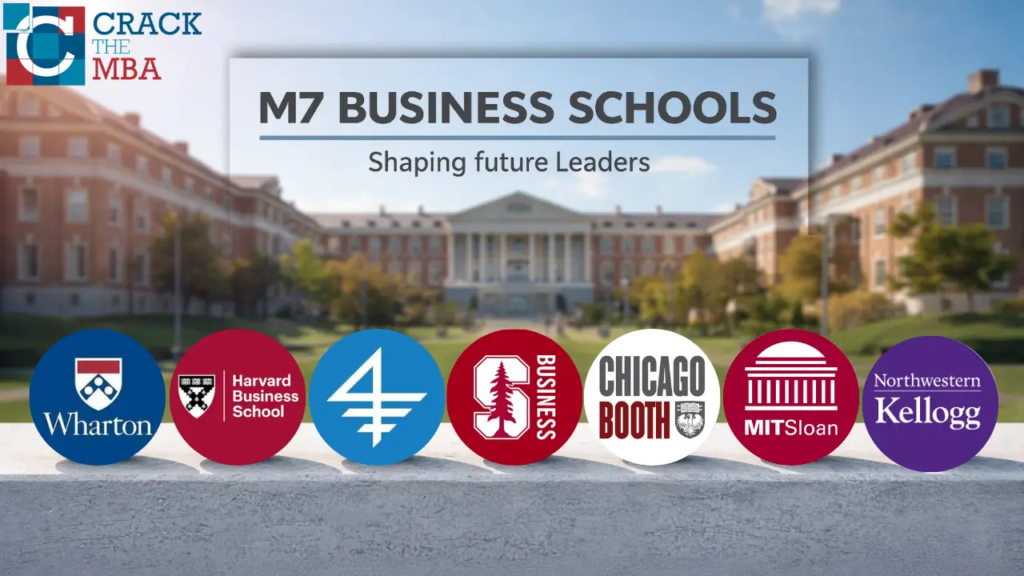
The M7 business schools are Harvard Business School, Stanford GSB, Wharton, Chicago Booth, Kellogg, Columbia Business School, and MIT Sloan. These seven US business schools are known as the “Magnificent Seven” because of their academic reputation, selective MBA admissions, powerful alumni networks, and consistently strong career outcomes.
An M7 MBA is the full-time MBA degree offered by one of these seven schools. For applicants, the M7 label matters because these programs are among the most competitive MBA programs globally and often lead to top-tier careers in consulting, finance, technology, private equity, venture capital, and entrepreneurship.
What sets the M7 business schools apart isn’t just their rankings. It’s their outsized influence on global business, finance, consulting, and entrepreneurship. Their alumni run Fortune 500 companies, found billion-dollar startups, and shape economic policy at the highest levels.
Whether you’re weighing your MBA options, just starting to explore graduate education, or simply curious about what makes these schools so sought-after, this guide breaks it all down from school profiles and admissions stats to culture, cost, and career outcomes.
What are the M7 Business Schools?
The M7 business schools, short for “Magnificent Seven,” represent an elite group of top-tier MBA programs in the world. These M7 business schools include:
- Columbia Business School
- Harvard Business School
- Stanford Graduate School of Business
- The Wharton School
- MIT Sloan School of Management
- Chicago Booth School of Business
- Kellogg School of Management
The Magnificent Seven (M7)
The most elite MBA programs in the world
Meet the 7 Schools
Harvard Business School
Boston, MAPerhaps the most recognized business school globally. Known for its case-method teaching and unmatched alumni network.
Stanford GSB
Stanford, CALocated in Silicon Valley, Stanford GSB is a top choice for applicants interested in entrepreneurship, technology, venture capital, and innovation.
Wharton
Philadelphia, PAThe University of Pennsylvania’s Wharton School is known for finance, analytics, private equity, investment banking, and a powerful global network.
Chicago Booth
Chicago, ILChicago Booth is celebrated for its flexible curriculum, rigorous analytical training, and deep strength in economics, finance, and consulting.
Kellogg
Evanston, ILNorthwestern Kellogg is famous for collaboration, leadership development, marketing strength, and a highly team-oriented MBA culture.
Columbia Business School
New York, NYColumbia Business School offers unmatched access to New York City, Wall Street, global companies, founders, investors, and senior executives.
MIT Sloan
Cambridge, MAMIT Sloan is rooted in innovation, entrepreneurship, technology, operations, and rigorous quantitative problem-solving.
What Unites an M7 MBA?
Selectivity
M7 programs attract thousands of highly qualified applicants and remain among the most selective MBA options.
Prestige
These schools are prioritized by top consulting firms, investment banks, private equity firms, and global technology companies.
Network
Their alumni networks span industries, geographies, functions, founders, investors, executives, and public-sector leaders.
Outcomes
M7 graduates typically command strong post-MBA career outcomes across consulting, finance, technology, and entrepreneurship.
Before diving deep, here’s a quick introduction to the seven schools that make up this elite group:
Harvard Business School (HBS) — Located in Boston, Massachusetts, HBS is perhaps the most recognized business school in the world. It’s known for its case-method teaching and its unmatched global alumni network of over 85,000 graduates.
Stanford Graduate School of Business (GSB) — Nestled in the heart of Silicon Valley, Stanford GSB is the most selective MBA program in the country. It’s the go-to school for aspiring entrepreneurs and those looking to break into the tech and venture capital worlds.
Wharton School – University of Pennsylvania — Based in Philadelphia, Wharton is the oldest business school in the United States and a powerhouse in finance, private equity, and investment banking.
Booth School of Business – University of Chicago — Known for its rigorous, data-driven curriculum and strong economics tradition, Booth consistently produces top talent in finance, consulting, and academia.
Kellogg School of Management – Northwestern University — Located in Evanston, Illinois, Kellogg has a strong reputation for marketing, leadership, and its highly collaborative, team-oriented culture.
Columbia Business School — Situated in New York City, Columbia offers students unparalleled access to Wall Street, global corporations, and a vast professional network in the world’s financial capital.
MIT Sloan School of Management — Rooted in MIT’s culture of innovation and analytical thinking, Sloan attracts students drawn to technology, entrepreneurship, and quantitative problem-solving.
What is an M7 MBA?
The M7 label isn’t assigned by any ranking body or publication. It’s an organic designation that emerged from the schools themselves. The seven schools formed an informal consortium decades ago, meeting periodically to exchange institutional data, discuss admissions trends, and benchmark their programs against one another. Over time, the group became recognized externally as the gold standard in business education.
But what actually unites these seven schools beyond the name? A few defining characteristics stand out.
Selectivity. M7 schools are among the hardest to get into in the world. Acceptance rates range from roughly 7% at Stanford to around 12–16% at schools like Kellogg and Columbia. Thousands of highly qualified applicants are turned away every year, making admission a genuine achievement.
Brand prestige. The M7 name carries enormous weight with recruiters. Top consulting firms like McKinsey, BCG, and Bain, as well as leading investment banks and tech giants, actively recruit on M7 campuses and, in many cases, prioritize them above all other schools.
Global alumni networks. Each M7 school boasts a sprawling network of alumni embedded in virtually every major industry and country. These networks don’t just open doors; they actively accelerate careers for decades after graduation.
Exceptional outcomes. M7 graduates consistently command some of the highest post-MBA salaries in the world, with median base salaries typically ranging from $175,000 to $200,000 or more, before signing bonuses and other compensation are factored in.
Together, these qualities create a self-reinforcing cycle: the best students attract the best recruiters, which drives better outcomes, which in turn draws more top applicants year after year.
Which is the Best M7 Business School for Your MBA Journey?
How to Choose the Right M7 MBA for You
How to Choose the Right M7 School for You
With seven world-class programs to choose from, the question shifts from “can I get in?” to “which school is actually right for me?” The honest truth is that no M7 school is objectively better than the others. Each has its own strengths, culture, and ecosystem.
1. Start With Your Career Goals
Investment banking or private equity? Wharton and Columbia are frontrunners. Entrepreneurship or VC? Stanford GSB’s Silicon Valley ecosystem is nearly impossible to beat. Consulting? Kellogg, HBS, and Booth send the highest proportions. Tech or PM? MIT Sloan and Stanford. Marketing? Kellogg remains the gold standard.
2. Match the Culture to Your Personality
HBS: Competitive, case-heavy. Stanford GSB: Mission-driven, collaborative. Wharton: Analytically rigorous. Booth: Intellectually independent, debate-friendly. Kellogg: People-first, warm community. Columbia: Urban, globally minded. MIT Sloan: Innovative, quantitative.
3. Think Carefully About Location
New York: Columbia, Wharton. Bay Area/Tech: Stanford, MIT Sloan. Chicago: Booth, Kellogg. Boston: MIT Sloan, HBS. Global: HBS, Wharton, Stanford.
4. Explore Program Formats and Dual Degrees
Part-time options exist at Booth, Kellogg, Columbia, and Wharton. Dual degrees: Wharton (Law/Med), Kellogg (MMM), MIT Sloan (AI/Engineering), Columbia (JD/MBA).
5. Do the Financial Math
Stanford and HBS offer generous fellowship awards averaging around $42,000 per year. Loan repayment assistance (LRAP) programs exist at several schools for nonprofits and early-stage startups.
With seven world-class programs to choose from, the question shifts from “can I get in?” to “which school is actually right for me?” The honest truth is that no M7 school is objectively better than the others. Each has its own strengths, culture, and ecosystem. The best choice depends entirely on you.
Here’s how to think through it.
1. Start With Your Career Goals
This is the single most important factor. Match the school’s known strengths to where you want to go:
- Investment banking or private equity? → Wharton and Columbia, with their Wall Street proximity and elite finance networks, are natural frontrunners.
- Entrepreneurship or venture capital? → Stanford GSB’s Silicon Valley ecosystem is nearly impossible to beat.
- Consulting? → All M7 schools place well, but Kellogg, HBS, and Booth send the highest proportions of their classes to top firms.
- Tech or product management? → MIT Sloan and Stanford offer the best pipelines into leading tech companies.
- Marketing or brand management? → Kellogg remains the gold standard.
The key is to be honest with yourself about what you want and let that drive your school selection rather than defaulting to the highest-ranked program you can get into.
2. Match the Culture to Your Personality
Culture shapes your entire MBA experience, and it matters more than most applicants realize. Here’s a quick snapshot of each school’s vibe:
| School | Known For |
|---|---|
| HBS | Competitive, generalist, case-heavy, leadership-focused |
| Stanford GSB | Mission-driven, introspective, collaborative, entrepreneurial |
| Wharton | Analytically rigorous, finance-forward, ambitious |
| Booth | Intellectually independent, data-driven, debate-friendly |
| Kellogg | People-first, team-oriented, warm community |
| Columbia | Urban, globally minded, entrepreneurial |
| MIT Sloan | Innovative, quantitative, builder mentality |
Visit campuses, talk to current students, and trust your gut. The vibe you feel walking around campus is a legitimate data point.
3. Think Carefully About Location
Location isn’t just a lifestyle choice — it directly affects your recruiting opportunities and long-term career geography. The MBA job market is more regional than people expect.
- New York → Columbia, Wharton
- Bay Area / Tech → Stanford GSB, MIT Sloan
- Chicago → Booth, Kellogg
- Boston / Biotech → MIT Sloan, HBS
- Global / Flexible → HBS, Wharton, Stanford
A simple rule: if you already know where you want to live after graduation, attending school in or near that city gives you a meaningful head start on building the alumni relationships and internship experience that will anchor your career there.
4. Explore Program Formats and Dual Degrees
All seven schools offer a full-time two-year MBA, but your options don’t stop there.
For working professionals not ready to leave their jobs, Booth, Kellogg, Columbia, and Wharton all offer well-regarded part-time and evening MBA programs. HBS and Stanford offer full-time programs only.
If your interests sit at the boundary of business and another field, a dual degree can give you a real edge:
- Wharton — joint degrees with Penn Law, Penn Medicine, and Engineering
- Kellogg — MMM Program with Northwestern Engineering (design thinking, product)
- MIT Sloan — cross-disciplinary ties with MIT’s AI, engineering, and life sciences departments
- Columbia — JD/MBA with Columbia Law School
5. Do the Financial Math
Total costs exceed $250,000 at most M7 schools, so it pays to look beyond the sticker price. A few things to factor in:
- Cost of living varies widely — New York and San Francisco are significantly more expensive than Chicago or Philadelphia.
- Fellowship and financial aid packages differ by school. Stanford and HBS offer generous fellowship awards averaging around $42,000 per year for eligible students.
- Loan repayment assistance (LRAP) programs exist at several schools for graduates who pursue lower-paying but high-impact careers in nonprofits, government, or early-stage startups. If this applies to you, investigate each school’s LRAP terms carefully.
The Bottom Line
Any M7 school will open extraordinary doors. But the students who get the most out of their MBA are those who chose intentionally because the culture resonated, the career resources aligned, and the community felt like home. Let that guide you more than any ranking ever could.
M7 Business Schools – Latest Numbers
Use this interactive tool to know everything about your target M7 business school. Select the M7 business school to get a detailed profile from an admissions point of view. This tool will help you research your target M7 business school for the 2026-2027 MBA application cycle.
M7 Explorer: Data at a Glance
Class of 2027 Profile Snapshot
Chart Title
M7 MBA Class of 2027: Profile Snapshot
If you’re aiming for one of the prestigious M7 business schools, understanding how you stack up against the latest incoming class is a great starting point. The M7 schools: Harvard, Stanford, Wharton, Kellogg, Columbia, Booth, and MIT Sloan are known not only for academic rigor and global prestige but also for attracting top-tier, diverse cohorts.
M7 MBA Class of 2027
Admissions & Demographics Profile
Academic & Global Standouts
Top GMAT Averages
- Stanford 738
- Chicago Booth 736
- Wharton 735
Top Undergrad GPAs
- Harvard 3.76
- Stanford 3.76
- Wharton 3.70
Most International
- MIT Sloan 42%
- Columbia 41%
- Stanford 39%
The following table presents a side-by-side comparison of the Class of 2027 across key metrics such as class size, academic and test score averages, gender diversity, and international representation.
M7 MBA Class of 2027 – Class Profile
| School Name | Class Size | Avg. Work Experience | Avg. GPA | Avg. GMAT | Avg. GRE | % Women | % International Students |
|---|---|---|---|---|---|---|---|
| Harvard Business School | 943 | 4.9 years | 3.76 | 730 | 328 | 44% | 37% |
| Stanford GSB | 434 | 5.1 years | 3.76 | 738 | 328 | 45% | 39% |
| The Wharton School | 888 | 5.0 years | 3.70 | 735 | 325 | 44% | 26% |
| Kellogg School of Management | 534 | 5.1 years | 3.68 | 733 | 324 | Not Reported | 37% |
| Columbia Business School | 900 | 5.0 years | 3.60 | 734 | 326 | 46% | 41% |
| Chicago Booth | 635 | 5.0 years | N/A | 736 | 324 | 41% | 37% |
| MIT Sloan | 450 | 5.0 years | 3.69 | 720 | N/A | 47% | 42% |
M7 Class of 2027 Comparison
Key Takeaways from the Class of 2027 Profile
Analyzing the latest numbers reveals three major trends for M7 applicants this year:
1. The “Standard” Experience is 5 Years
Across the board, the average work experience has converged to exactly 5 years. While schools technically accept applicants with less, the data suggests that 4–6 years of quality professional experience is the “sweet spot” for admission. If you are applying with fewer than 3 years of experience, your academic stats and leadership potential need to be exceptional to compete.
2. Test Scores Remain Sky-High
Despite the rise of test waivers in lower-ranked programs, M7 schools remain incredibly competitive. The average GMAT score for the M7 is now firmly in the 730+ range, with Stanford GSB leading at 738. If you are submitting a GRE, a combined score of 324–328 is the new baseline for a competitive application.
3. Diversity Shifts: MIT leads, Kellogg holds back
This year marked a significant shift in transparency. MIT Sloan led the pack with 47% women, nearing gender parity. In contrast, Kellogg surprisingly chose not to report its percentage of women for the Class of 2027, a departure from industry norms that has sparked discussion among applicants. Meanwhile, Columbia and MIT continue to be the most global, with over 40% international students, making them top choices for applicants from abroad.
M7 MBA Class of 2025: Employment Outcomes
The M7 business schools- Harvard, Stanford, Wharton, Booth, Columbia, Kellogg, and MIT Sloan continue to set the gold standard for post-MBA career outcomes. Despite a cooling overall hiring market, the Class of 2025 saw base salaries jump to record highs, alongside a massive resurgence in tech hiring and entrepreneurial ventures across these powerhouse programs.
M7 MBA Class of 2025
Post-MBA Employment Outcomes & Highlights
Industry Dominance: The Big 3
Consulting
- Kellogg 38.0%
- Booth 36.7%
- MIT Sloan 33.0%
Finance
- Wharton 38.2%
- Columbia 35.4%
- Stanford GSB 33.0%
Technology
- Stanford GSB 35.0%
- MIT Sloan 23.0%
- Harvard 22.0%
Here’s how the Class of 2025 fared:
M7 Class of 2025 Career Outcomes
| School | Base Salary | Signing Bonus | Offers | Acceptances | Consulting | Finance | Tech | U.S. Placements | International Placements | Founders |
|---|---|---|---|---|---|---|---|---|---|---|
| Harvard | $184,500 | $30,000 | 90% | 84% | 21% | 27% | 22% | 88% | 12% | 17% |
| Stanford GSB | $185,000 | $30,000 | 90% | 81% | 11% | 33% | 35% | 90% | 10% | 16% |
| Wharton | $185,000 | $30,000 | 91% | 87% | 28.2% | 38.2% | 16.9% | 90% | 10% | 5.2% |
| Booth | $175,000 | $30,000 | 89.1% | 87.8% | 36.7% | 31.6% | 14.1% | 94% | 6% | 4% |
| Columbia | $175,000 | $30,000 | 92% | 90.2% | 30.6% | 35.4% | 10.2% | 80% | 20% | Not Reported |
| Kellogg | $175,000 | $30,000 | 88% | 86% | 38% | 21% | 19% | 94% | 6% | 3.7% |
| MIT Sloan | $175,000 | $30,000 | 91% | 87.1% | 33% | 20.6% | 23% | 94% | 6% | 11.1% |
1. Job Offer & Acceptance Rates
Job Offers vs Job Acceptances
| School | Job Offers (3 months) | Job Acceptances (3 months) |
|---|---|---|
| HBS | 90% | 84% |
| Stanford GSB | 90% | 81% |
| Wharton | 91% | 87% |
| Booth | 89.1% | 87.8% |
| Columbia | 92% | 90.2% |
| Kellogg | 88% | 86% |
| MIT Sloan | 91% | 87.1% |
Insight: Columbia and Wharton led the pack with the highest reported job acceptance rates, though all schools saw slightly slower hiring timelines compared to the post-pandemic boom, reflecting a more deliberate recruiting cycle.
2. Top Industries: Where the Class Went
Top Industries: Consulting vs Finance vs Technology
| School | Consulting | Finance | Technology |
|---|---|---|---|
| HBS | 21% | 27%* | 22% |
| Stanford GSB | 11% | 33%* | 35% |
| Wharton | 28.2% | 38.2% | 16.9% |
| Booth | 36.7% | 31.6% | 14.1% |
| Columbia | 30.6% | 35.4% | 10.2% |
| Kellogg | 38% | 21% | 19% |
| MIT Sloan | 33% | 20.6% | 23% |
*Includes private equity, venture capital, and hedge funds.
Insight:
- Consulting: Kellogg, Booth, and Sloan continue to dominate consulting pipelines, sending over a third of their class to firms like McKinsey, BCG, and Bain.
- Finance: Wharton and Columbia remain the undisputed titans of Wall Street.
- Technology: Tech staged a massive comeback at Stanford (jumping to 35% to surpass finance) and HBS (22%), reflecting a pivot toward AI and West Coast innovation hubs.
3. Compensation Overview
Median Salary & Bonuses
| School | Median Base Salary | Median Signing Bonus | Performance Bonus (Median) |
|---|---|---|---|
| HBS | $184,500 | $30,000 | Data not specified |
| Stanford GSB | $185,000 | $30,000 | Data not specified |
| Wharton | $185,000 | $30,000 | Data not specified |
| Booth | $175,000 | $30,000 | Data not specified |
| Columbia | $175,000 | $30,000 | Data not specified |
| Kellogg | $175,000 | $30,000 | Data not specified |
| MIT Sloan | $175,000 | $30,000 | Data not specified |
Insight: Base salaries reached new milestones for the Class of 2025. Stanford and Wharton now lead the pack with a median base of $185,000, closely followed by HBS at $184,500. Across the board, the standard median signing bonus remains locked at $30,000.
4. Geographic Distribution
U.S. vs International Placements
| School | U.S. Placements | Top U.S. Regions | International Placements |
|---|---|---|---|
| HBS | ~88% | Northeast, West | ~12% |
| Stanford GSB | ~90% | West, Northeast | ~10% |
| Wharton | ~90% | NYC, SF, Boston | ~10% |
| Booth | 94% | Midwest (39%), Northeast | 6% |
| Columbia | 80% | NYC-heavy | 20% |
| Kellogg | 94% | Midwest (39%), West (25%) | 6% |
| MIT Sloan | 94% | Northeast (52%), West | 6% |
Insight: Columbia remains the most globally dispersed, sending 20% of its class internationally. Meanwhile, Booth, Kellogg, and Sloan heavily funnel talent into traditional U.S. domestic markets, largely anchored around their home regions (Midwest and Northeast).
5. Entrepreneurship & Startups
% Started a Business vs Joined a Startup
| School | Started a Business (%) | Joined a Startup (%) | Median Startup Salary |
|---|---|---|---|
| HBS | 17% | 17% | Data not stated |
| Stanford GSB | 16% | Data not specified | High VC/Tech placements |
| Wharton | 5.2% | Data not specified | Not stated |
| Booth | ~4% | Not specified | Not specified |
| Columbia | Not stated | Not stated | Not stated |
| Kellogg | 3.7% (20 students) | Not specified | Not stated |
| MIT Sloan | 11.1% | Not specified | Not specified |
Insight: HBS saw a record-breaking surge in entrepreneurship, with 34% of the class either founding their own company (17%) or joining a startup (17%). Stanford and MIT Sloan also remain elite incubators for founders.
6. Top Functions by Hiring Volume
Finance vs Consulting vs Tech Hiring
| School | Top 3 Functions |
|---|---|
| HBS | Finance, Tech, Consulting |
| Stanford GSB | Tech, Finance, Consulting |
| Wharton | Finance, Consulting, Tech |
| Booth | Consulting, Finance, Tech |
| Columbia | Finance, Consulting, Tech |
| Kellogg | Consulting, Finance, Tech |
| MIT Sloan | Consulting, Tech, Finance |
Insight: The “Big Three” functions remain unshakable, but the order shifted in 2025. Product management, AI strategy, and tech operations surged ahead of consulting at both Stanford and MIT Sloan.
Takeaways
- Compensation broke records despite a tougher economy, with Wharton, Stanford, and Harvard graduates all pushing base medians to $184.5K–$185K.
- Tech is back: After a dip in 2024, technology hiring rebounded aggressively, notably becoming the #1 destination for Stanford grads.
- Entrepreneurship is thriving as an alternative to corporate paths, especially at HBS (17% founders) and Stanford (16% founders).
- Location matters: Stanford grads lean west, Columbia heavily favors NYC, Sloan stays in Boston, and Booth/Kellogg command the Chicago/Midwest markets.
- Career services proved their worth this cycle. While offers took slightly longer to secure compared to the pandemic peak, acceptance rates still hovered near 90% across the board by the three-month mark.
M7 Business Schools – Cost of Attendance
Pursuing an M7 MBA is a serious investment. For the 2025–2026 academic year, the total first-year cost of attendance has crept up across the board, with several schools now exceeding $130,000 per year. However, each school offers a robust mix of need-based aid, fellowships, and merit-based scholarships to help reduce the financial burden.
M7 Financial Overview
Tuition, Scholarships & ROI (2025–2026)
The Three Scholarship Models
Need-Based Giants
Massive endowments used strictly to help lower-income admits afford the program. No merit scholarships awarded.
- Harvard (HBS)
- Stanford GSB
Merit-Based Leaders
Aggressively use fellowships to attract top talent, boost yield rates, and reward academic/professional excellence.
- Wharton
- Chicago Booth
- Kellogg
- MIT Sloan
The Hybrid Approach
Actively balances formal need-based aid applications with targeted merit scholarships to build the incoming class.
- Columbia
Let’s compare the first-year cost of attendance and the key scholarship insights across the M7:
First-Year Cost of Attendance (2025–2026)
| Business School | Tuition | Living + Fees | Health Insurance | Total Cost (Year 1) |
|---|---|---|---|---|
| Columbia Business School | $91,172 | $41,032 | $5,367 | $137,571 |
| Stanford GSB | $85,755 | $40,971 | $9,045 | $135,771 |
| Wharton (UPenn) | $87,970 | $39,772 | $4,662 | $132,404 |
| Chicago Booth | $87,354 | $42,049 | Included/Varies | $129,403 |
| Kellogg (Northwestern) | $86,370 | $36,563 | $5,919 | $128,852 |
| MIT Sloan | $89,000 | $34,830 | $4,204 | $128,034 |
| Harvard (HBS) | $78,700 | ~$41,728 | $6,108 | ~$126,536 |
(Note: “Living + Fees” is an estimate provided by each school covering room, board, transportation, mandatory university fees, and books for a single student. Actual costs will vary based on your personal lifestyle and whether you are moving with a partner or family).
Scholarships & Fellowships at M7 Schools
While the sticker price is high, very few students pay the full amount out-of-pocket. M7 schools provide millions of dollars in aid each year, but their approaches differ fundamentally:
| School | Primary Aid Model | Average / Notable Awards | Special Fellowships |
|---|---|---|---|
| Stanford GSB | Purely Need-Based | ~$47,000/year (avg. fellowship) | Knight-Hennessy, BOLD, Summer Stipends |
| Harvard (HBS) | Purely Need-Based | ~$46,000/year (avg. fellowship) | Boustany, Horace W. Goldsmith, Summer Fellows |
| Wharton | Merit-Based | Varies widely based on profile | Joseph Wharton, Prism (LGBTQ+), Moelis, Forté |
| Chicago Booth | Merit-Based | Varies widely | Kilts, Harper, Wallman, Forté, PE Fellowships |
| Kellogg | Merit-Based | Extensive (amounts not disclosed) | F.C. Austin Scholars, Finance Fellows, Zell |
| Columbia | Mix (Need & Merit) | ~$20,000/year (avg. need award) | Feldberg, Meyer, Emerging Market, Real Estate |
| MIT Sloan | Merit-Based | Amounts not disclosed | McKinsey Award, Legatum, Dean’s Fellowships |
Key Insights:
- Need vs. Merit: Stanford and HBS do not give merit scholarships; their vast endowments are used exclusively for need-based aid, making them surprisingly affordable for lower-income applicants. Conversely, Wharton, Booth, Kellogg, and Sloan use merit scholarships to attract top talent and boost their yield rates.
- Columbia’s Unique Approach: CBS is one of the few M7 schools that actively balances both a formal need-based application process and aggressive merit-based scholarships.
Final Thoughts on ROI
While the total cost of a 2-year M7 MBA now approaches or exceeds $260,000 (when factoring in tuition hikes and living expenses), the long-term math remains highly favorable.
With median base salaries hitting $175,000 to $185,000 for the Class of 2025, plus $30,000 signing bonuses, most graduates achieve a full financial payback within 3 to 5 years. When you layer in tax-free fellowships and scholarships, the financial ROI of an M7 degree is incredibly strong. Additionally, all M7 schools facilitate specialized loan programs, including no-co-signer options for international students, to ensure that admitted students can finance their journey.
Now that you have a sense of how much it costs to attend an M7 business school, let’s see the lifelong value that being a part of an M7 business school can add to your life. Here are details on the alumni networks of M7 business schools.
Take a look at these comprehensive guide to get into 3 top MBA Programs – Harvard Business School, The Wharton School, and Stanford GSB.
M7 MBA Alumni Networks
A robust alumni network provides invaluable contacts, insights, information, and inroads into a new profession or industry. It also gives you the chance to stay engaged and involved with your classmates.
Alumni can be a great source of support as you go through life. Talking to alumni of desired business schools can help you learn more about the school’s culture, its alumni network, and employment opportunities.
A Bloomberg survey ranked Stanford’s alumni network as the best of all schools for helping graduates find employment.
Nearly 15,000 MBA alumni from 126 different schools around the world took part in the survey and rated their school’s alumni network in terms of its depth, breadth, and responsiveness. Based on their alumni networks, here is how the M7 business schools are ranked:
Harvard Business School
Harvard Business School has about 85,000 alumni in 173 countries. Leaders in many fields, HBS grads have risen to the top. There are 104 alumni clubs that offer professional, social, and educational initiatives to global leaders.
Here are a few well-known HBS MBA graduates:
- Rahul Bajaj, 1964 – CEO of Bajaj Auto
- Sheryl Sandberg, 1995 – COO of Facebook
- George W. Bush, 1975 – 43rd President of the United States and former Governor of Texas
- Salman Khan, 2003 – founder of Khan Academy
- Naina Lal Kidwai, 1982 – Group General Manager and Country Head of HSBC India
- Robert Kraft, 1965 – chairman and CEO of The Kraft Group, owner of the New England Patriots and New England Revolution
- Michael Bloomberg, 1966 – CEO of Bloomberg LP and former mayor of New York City
- Stephen Schwarzman, 1972 – Chairman and CEO of the Blackstone Group
- Ray Dalio, 1973 – Founder and Co-Chief Investment Officer of the Bridgewater Associates
- Jamie Dimon, 1982 – CEO and chairman of JPMorgan Chase
Stanford GSB
With over 30,000 graduates, the Stanford Graduate School of Business has a large and active alumni community that is actively engaged in fostering professional growth and fostering strong networks for its members.
Some famous people who went to Stanford GSB include:
- Mukesh Ambani, Billionaire Indian Businessman and Chairman of Reliance industries
- Phil Knight, Billionaire Founder and Chairman of Nike
- Mary Barra, Chairman, and CEO of General Motors
- Rishi Sunak, Prime Minister of the United Kingdom (2022–present)
- Jeffrey Bewkes, Chairman and CEO of Time Warner
- Roelof Botha, Venture Capitalist, Sequoia Capital Global Head
Wharton
Wharton’s alumni network is over 100,000 alumni spread throughout 153 countries. Students, staff, and faculty can get involved in the 77 clubs that are independent, self-supporting, and run by volunteers.
Here are some of the most famous people who went to Wharton:
- Sundar Pichai, CEO of Alphabet and Google
- Ashwini Vaishnaw, Indian Politician and Current Minister of Railways and Minister of IT and Communications
- Robert S. Kapito, founder and president of BlackRock (the world’s largest asset manager)
- Rakesh Gangwal, chairman and CEO of US Airways
- Vikram Limaye, Managing Director and CEO of the National Stock Exchange of India Limited
- Anil Ambani, chairman of Reliance Group
- Sachin Pilot, Indian politician
Columbia Business School
Over 45,000 people have graduated from Columbia Business School, and there are 80 alumni groups in different countries. The alumni network’s mission is to provide its members with a variety of networking, learning, and professional development opportunities. Here are some of the most well-known alumni from CBS include:
- Benjamin M. Rosen, MBA 1961, Former chairman and CEO of Compaq
- Beth Ford, MBA 1995, CEO of Land O’Lakes
- Beverly Leon, MBA 2020, former midfielder for Sunderland A.F.C. Ladies
- Harvey Schwartz, MBA 1996, president and COO of Goldman Sachs
- Henry Kravis, MBA 1969,[57] Founder of Kohlberg Kravis Roberts & Co.
- Henry Swieca, MBA 1982, Co-Founder of Highbridge Capital Management, Founder of Talpion
- Jon Stein, MBA 2009, Founder and CEO of Betterment
- Jon Steinberg, MBA 2003, President of BuzzFeed
Kellogg School of Management
Across the globe, there are more than 65,000 graduates of Kellogg School of Management who are leaders in their fields. Roughly 35 alumni groups exist outside the United States, whereas there are 28 in the United States.
Some of the most well-known alumni from Kellogg’s MBA program include:
- Roshni Nadar, Executive Director, and CEO, HCL Corporation, Founder and CEO of the Shiv Nadar Foundation
- Darren Woods, Chairman, and CEO, ExxonMobil
- Pankaj Sahni – CEO at Medanta
- Kushagra Bajaj, Vice Chairman, Bajaj Hindusthan
- Chris Kubasik, former President and COO Lockheed Martin
- Alexander De Croo, Prime Minister of Belgium
- Christopher Galvin, Former Chairman and CEO of Motorola
- Ginni Rometty, Former CEO of IBM (2012-2020)
Chicago Booth School of Business
Chicago Booth boasts a global alumni community of 55,000 people, with roughly 10,000 of them working in C-suite roles. There are over 90 alumni clubs throughout the world where Booth grads can continue to mingle, network, and feel a part of the global Booth family. Some of the most famous alumni of Chicago Booth include:
- Satya Nadella, CEO at Microsoft
- Jon Corzine, former CEO of Goldman Sachs, former governor of New Jersey
- Brady Dougan, former CEO of Credit Suisse Group
- James M. Kilts, founding partner of Centerview Partners; former chairman, president, and CEO of Gillette Company
- Eric Kriss, co-founder of Bain Capital
- Mark Loughridge, CFO of IBM
- Matt Maloney, co-founder and CEO of GrubHub
- Dhiraj Rajaram, founder and CEO of Mu-Sigma
MIT Sloan School of Management
MIT Sloan graduates are instantly connected to a network of more than 24,000 MIT Sloan alumni and over 136,000 MIT alumni, who are successful leaders and innovators in a wide range of companies and fields worldwide.
Some of the most famous alumni from MIT Sloan include:
- Adi Godrej, chairman, Godrej Group
- Robin Chase, Co-founder and former CEO of Zipcar
- Douglas Leone, managing partner, Sequoia Capital
- Sumantra Ghoshal, founding dean, Indian School of Business
- Ron Williams, former CEO, Aetna
- Thornton Wilson, former CEO, Boeing
- Randy Woelfel, CEO, Nova Chemicals
- Kofi Annan, 7th Secretary-General of the United Nations
Final Thoughts
Getting into M7 business schools can have a long-lasting impact on your career and can boost your career in more ways than you can imagine. If M7 business schools are on your list of target business schools, reach out to our team today to get started on your journey to Crack The MBA at M7 business schools.